1. A brief introduction to integrated servo motors
An integrated servo motor is a servo system that highly integrates motors, encoders, and drivers. Compared with traditional distributed servo motors, integrated servo motors reduce the number of cable connections, greatly reducing the size of the entire servo system and making it easier to install in equipment, especially those with limited internal space.
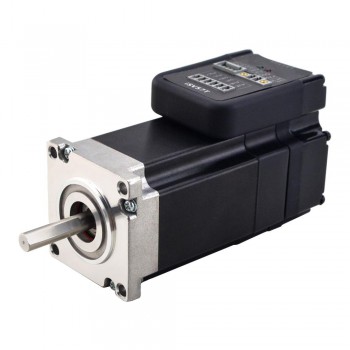
2. Basic components of integrated servo motors
1. Motor body: This is the actuator that realizes mechanical movement, usually including a DC motor or an AC motor. DC motors convert the direction of current through brushes and commutators, while AC motors work through electronic commutation.
2. Driver: Responsible for receiving control signals and driving the motor to rotate. The driver provides appropriate current and voltage to the motor according to the instructions of the control circuit to achieve precise control.
3. Control circuit: Generates control signals and monitors the operating status of the motor. The control circuit receives input signals from an external controller, processes them and sends them to the driver, and monitors the actual position or speed of the motor through feedback devices (such as encoders or potentiometers), compares them with the target value, and adjusts the operating parameters of the motor.
3. Key design of integrated servo motor
1. Performance optimization of motor body: By studying the pole slot matching, harmonic magnetic potential and cogging torque of fractional slot concentrated winding permanent magnet motor, the constraint conditions for selecting the number of pole slots of high-performance fractional slot concentrated winding permanent magnet motor are proposed. The improved motor design scheme can significantly reduce the amplitude of the first harmonic, reduce eddy current loss and cogging torque fluctuation.
2. System thermal design optimization: The higher power density of the integrated servo motor leads to higher temperature rise. It is necessary to study the temperature field distribution of the system and optimize the thermal design of the system. By establishing a three-dimensional electromagnetic thermal coupling model, nonlinear processing of thermal boundary conditions, and actual measurement correction of the motor body loss density, the overall optimized integrated servo motor thermal model and design scheme are finally obtained.
3. Electromagnetic interference suppression: PWM technology improves system performance while also bringing electromagnetic interference. By analyzing the turn-off process of MOSFET, a closed-loop gate voltage control method is proposed and designed to effectively suppress voltage overshoot and oscillation and reduce turn-off loss.
4. Component selection and integrated design: The principles of integrated thermal structure design and electromagnetic compatibility design between the four major components of the integrated servo motor (motor body, driver, controller, encoder) and the selection principles of each major component are proposed. Select fractional slot concentrated winding, design high-performance encoder and adopt self-developed single-chip servo controller to improve the reliability and compactness of the system.
5. Material and process selection: In terms of material selection, focus on selecting materials with high magnetic permeability and low loss; in terms of process, use advanced manufacturing technologies such as precision casting and precision machining to ensure the performance and reliability of the motor.
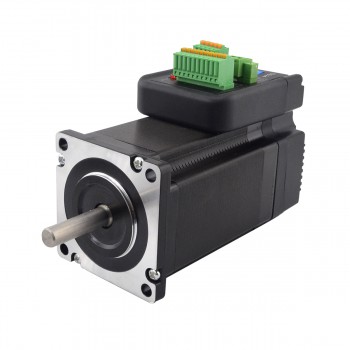
4. Reasons for overheating of integrated servo motors
1. Failure of the cooling system: The integrated servo motor will generate a lot of heat during operation. If the cooling fan fails, the heat sink is blocked or the fan rotates in the wrong direction, the heat will not be effectively dissipated, causing the motor to overheat.
2. Excessive load: When the integrated servo motor runs for a long time in a state exceeding its rated load, the internal current of the motor increases and generates more heat. If the load is not adjusted in time or the motor of suitable power is replaced, the aging of the motor will be accelerated and even cause failure. 3. Overcurrent: Insecure power wiring, unbalanced three-phase current, or motor bearing wear may cause overcurrent, which in turn increases the internal resistance of the motor and increases the heat generation.
4. High ambient temperature: The heat dissipation efficiency of a servo motor operating in a high temperature environment will be greatly reduced. Even if the heat dissipation system works normally, it is difficult to discharge the heat generated by the motor in time, which may cause overheating.
5. Improper control system settings: Unreasonable control system parameter settings, such as speed monitoring parameters, current limit parameters, etc., may cause abnormal conditions during motor operation, which may lead to overheating.
6. Harmonic interference: The voltage waveform at the output end of the servo drive is not a standard sine wave, but a square wave. This waveform contains a large number of harmonics, which may cause problems such as overheating and vibration of the integrated servo motor.

請先 登入 以發表留言。