1. Basic concepts of hollow shaft stepper motors
Hollow shaft stepper motors are an open-loop control motor that converts electrical pulse signals into angular displacement or linear displacement. They are a special type of stepper motor structure. In the case of non-overload, the motor speed and stop position depend only on the frequency and number of pulses of the pulse signal, and are not affected by load changes.
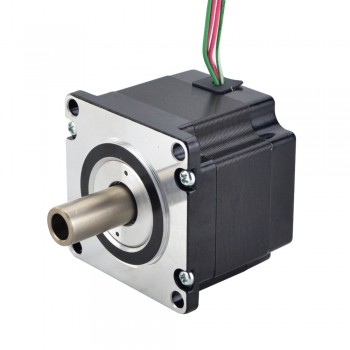
2. Working principle of hollow shaft stepper motors
The working principle is based on the action of electromagnets: when a phase of the stator is excited, it attracts the rotor so that the teeth of the rotor correspond to the teeth on the stator pole of that phase. At this time, the rotor rotates a fixed angle (called "step angle"). By continuously energizing each phase in turn, the rotor can continue to rotate. This motor controls the angular displacement by controlling the number of pulses to achieve accurate positioning, and controls the speed and acceleration by controlling the pulse frequency.
3. Optimization methods for hollow shaft stepper motors
1. Closed-loop control system: The use of a closed-loop control system (such as Ezi-SERVO) can monitor the motor position in real time and adjust the motion parameters through encoder feedback, significantly improving positioning accuracy and dynamic response capabilities, especially for low-stiffness load scenarios.
2. Current control optimization: Dynamically adjusting the current through constant current control technology can reduce vibration and noise and improve running stability. Combined with the load automatic current adjustment strategy, energy consumption can be reduced at low loads and output torque can be enhanced at high loads.
3. Structural and material improvements: Optimizing the stator and rotor structure (such as multi-layer stator design, permanent magnet surface treatment) can improve magnetic field utilization and torque density, while reducing magnetic resistance loss. Air gap optimization (size and shape adjustment) can enhance magnetic flux density and increase output power.
4. Bearing system optimization: Selecting high-performance bearing materials and designing a reasonable structure can reduce friction loss and operating noise and extend service life.
5. Drive scheme adaptation: Optimize the drive parameter configuration for hollow shaft design characteristics (such as cable or pipe insertion) to ensure signal transmission stability and response speed.
4. Maintenance tips for hollow shaft stepper motors
1. Cleaning work: Keep the motor surface clean, blow away dust with compressed air, and wipe the surface dirt clean. This can prevent dust and oil accumulation, avoid machine clogging, and ensure the normal operation of the motor.
2. Check parts: Regularly check the various parts of the motor, including the stator core, coil, rotor pole coil, etc., to ensure that they are in good condition. If a fault is found, it should be repaired or replaced in time.
3. Bearings and lubrication: Observe the oil quantity and oil quality of the bearing to ensure that the oil quantity is sufficient and the oil quality is good. If the oil quantity is insufficient, it should be added in time. At the same time, clean the oil ring to ensure that the oil ring is clean during the next operation.
4. Environmental requirements: Hollow shaft stepper motors should be stored in a clean, well-ventilated warehouse with an ambient temperature of -40~+50℃ and a relative humidity of no more than 95%. Handle it with care during transportation to avoid collision and impact. Avoid contact with corrosive substances such as acids and alkalis.
5. Connection maintenance: Ensure that the signal line, motor line and power line are firmly connected to prevent poor contact from causing heat and burning the plug and socket. The power supply should be supplied through an isolation transformer to protect personal and equipment safety.
6. Thermal protection and lubrication: When the motor thermal protection continues to operate, the cause must be found and the fault must be eliminated before it can be re-operated. At the same time, check the lubrication condition regularly to ensure that the motor runs in a good lubrication state to reduce wear and extend service life.

請先 登入 以發表留言。